One of my earliest experiences of working creatively as a counselling student began with a walk outside and a simple invitation: find an object that represented how I saw myself at the start of the course.
I chose a closed sweet chestnut.
Its spiky outer shell felt protective. It kept the softer parts safely inside, with only a small opening through which they might occasionally be glimpsed. At the time, it seemed to capture something important about boundaries, vulnerability, and how much of ourselves we choose to show to others. What surprised me most was not the object I chose, but how uncomfortable I found the task itself.
I had expected counselling training to involve listening, reflection, theory and practising skills. I had not expected to be standing outside, searching for an object and wondering whether I had understood the exercise correctly. I wanted to know what the finished answer was supposed to look like.
Creative work offered no reassurance.
There was no perfect object to find and no single correct interpretation to give. The value was not in producing something impressive. It lay in noticing what I was drawn to, what feelings emerged, and what the metaphor allowed me to express.
That felt both exposing and vulnerable!
When words are not quite enough
I usually feel more comfortable when I can think something through and explain it clearly. Creativity disrupted that familiar process. Rather than beginning with an organised account of how I felt, I began with texture, shape and instinct.
The sweet chestnut helped me express something I had not yet found the words for. Its protective outer shell was not merely something to break through or discard. It represented boundaries that had served a purpose. The small opening also suggested that protection and connection need not be opposites.
We can keep ourselves safe while gradually allowing ourselves to be seen.
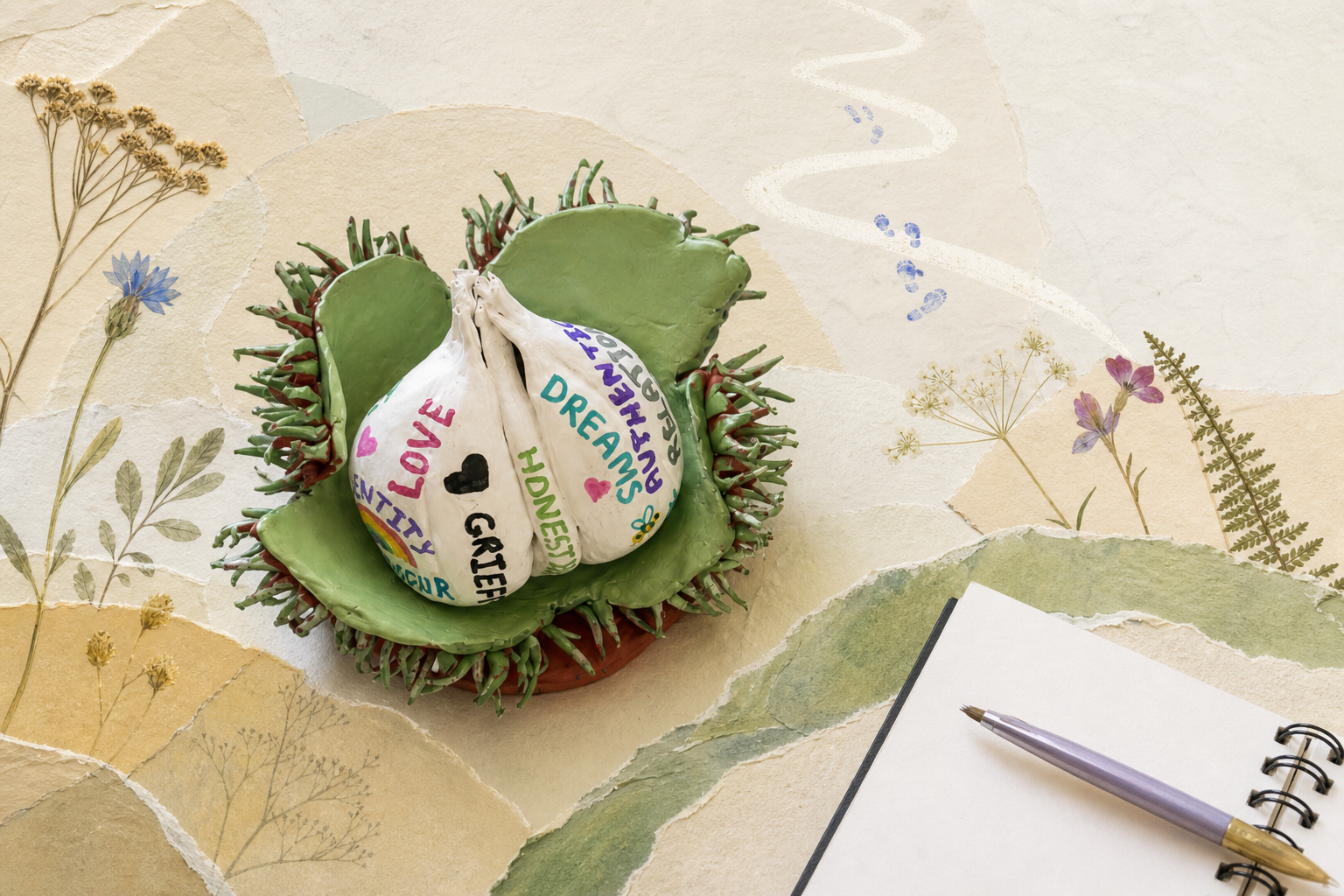
Later in the course, I returned to the metaphor and created a clay version of the chestnut. This time, the shell was open. Inside, I decorated it with words and symbols representing values, hopes and parts of myself that mattered.
The finished piece was imperfect, colourful and unmistakably handmade. It did not need to be technically accomplished to be meaningful.
In fact, its imperfections felt significant.
Creativity did not ask me to explain myself perfectly. It simply gave me a place to begin.
Moving beyond the fear of getting it wrong
Making the clay piece brought up some of the same uncertainty I had experienced during the original exercise. I noticed the familiar temptation to judge what I was producing or to imagine how it might be received.
Was it good enough? Was it too simple? Had I understood the task correctly?
Those questions felt strangely similar to some of my early experiences practising counselling skills. At first, I spent a great deal of time thinking about what to say next. I wanted to offer the right reflection, ask the right question and demonstrate that I understood the skills I was learning.
That effort sometimes drew my attention away from the relationship in front of me.
Over time, I have come to understand that counselling is not about producing a perfectly polished response. Skills matter, but so do presence, curiosity and the ability to stay alongside another person without rushing to an answer. Creative work invited me to practise something similar. I had to loosen my grip on the outcome, remain curious and allow the process to unfold.
Creativity as another language
I am beginning to see creativity as another possible language for reflection.
Words are powerful, but they are not always the first or easiest way to enter an experience. An object, colour, image or piece of clay can sometimes give form to something that still feels indistinct. I have felt that metaphor can create a little distance, making it possible to approach an emotion without having to explain everything at once.
That does not mean creative work will feel comfortable or helpful for everyone. It should never be imposed, and the person exploring must remain in control of what they create, what it means, and how much they choose to share. I certainly found it uncomfortable at first and have been cautious about how much I share, because it felt like part of a process for me!
What interests me is the possibility it offers. A person-centred, humanistic approach values the individual’s own meaning rather than imposing an interpretation on them. From that perspective, a creative object does not need to be decoded by someone else. Its significance belongs to the person who made or chose it.
The shell can open without disappearing
Looking at the finished chestnut now, I do not see a story about removing every protective layer. I see something gentler. The shell remains. The boundaries are still present (and important).
That feels more honest than the idea that growth requires me to reveal everything or abandon every defence I’ve built. Healthy boundaries allow openness to happen with choice, trust and an appropriate sense of safety, in a safe and supportive environment.
I am still learning to trust creative work and to tolerate the vulnerability that can accompany it. But I am also increasingly curious about where it might lead—both in my own development and in my future counselling training.
Perhaps creativity is not a diversion from the path after all, and it may even help me on my way.